
Latest Insights

Thoughts, updates, and inspirations from our team — shared with you.

Tacking to the Wind (Confluence Part 2)

Folks have asked me why I started WE-Empower. How does a Singaporean American end up in Bali? How does a leadership coach end up thinking about building grassroots enterprises?

This is a story of confluence. When winds shift, we tack.

In March 2020, I was in South Africa coaching high-potential executives  of a global financial company when the program was cancelled due to Covid-19. I was about to return to New York City where we’d been living for a decade, when a friend who owned a villa in Bali called: his guests had cancelled, would my partner (originally from Vietnam) and I like to quarantine for a month or two? We took up the offer. Two months stretched into two years. During that time, the geopolitical tides of the world shifted, and we found ourselves reconnecting to Southeast Asia.

Neither of us had grown up thinking about ourselves as Southeast Asian. It is not really an identity, and certainly in the 1960s and ’70s of our youth, we hardly knew what this neighbourhood was about. It was either too troublesome to visit or in some kind of turmoil. Our imagination was focused on the West — to get there, which we both did for different reasons.

Over the years we had often visited Vietnam and Singapore. We had even started a non-profit with friends, SEALNet (the Southeast Asian Service Leadership Network), which for nearly two decades brought Southeast Asian undergraduates studying in the USA back to work on service projects in the countries of the region. We had been connected to the neighbourhood, but home was still America.

Now, with shifting winds, we felt called to make this neighbourhood our home.

As leadership coaches, our work continued online, but we began having regional clients, many running family businesses. We started moving into the succession space — helping families with their inter-generational dynamics, something we both still do.

In 2023, I started WE-Empower by asking a client for a donation. The mission was for business families to empower grassroots enterprises, with a focus on climate change. President — then DPM — Tharman Shanmugaratnam of Singapore was our Guest of Honor when we launched. 

With a fellow UWC alumnus, I visited Leuser National Park in Aceh, Sumatra, with a view to funding restoration of depleted lands with bamboo. The forests of Leuser, where endangered orangutans and white rhinos still live, were being systematically reduced. Palm oil plantations had cut into them, and the lowlands were flooding. Palm oil is here to stay — it is one of Indonesia’s largest foreign exchange earners and a common ingredient in hundreds of products. There is no good substitute. But people living next to the forests were often tempted to go in: cut timber for sale, poach animals, plant a few oil palms they could harvest. Cash was what they needed — for school, clothing, medicine, gasoline. Food they could grow. Each time a migrant labourer from a village fails to send back enough money, family members turn to the forest.

For the vast majority of millions of people in Southeast Asia living next to forests or the sea, nature is their bank of last resort. When they cannot find employment in the modern economy, they take bits and pieces from it. (Industrial-scale extraction is the larger problem, not the rural people taking — but that is an issue I am not addressing here, because I do not know how.)

Bamboo could do two things. It could restore degraded land over five to seven years, leading to soil conservation, flood prevention and reforestation. And it could give villagers a living — first through donations to plant, then eventually through harvesting for sale. The forest can then be an investment instead of a bank they drain.

As shifting winds would have it, the donor changed their priorities, and we could not fund the project. But I had learned the lesson that has shaped WE-Empower since. Making a living is the number one priority for the vast majority of people. It is not about saving for university; it is more basic — buying a tin roof, medicine for a sick child. They need viable businesses to run, or to employ them. Grassroots enterprises — micro, small, and medium-sized — are the key to human survival in this region, to addressing climate change, and to political stability itself.

In my coaching work, I had been focused on business families and Next Gen succession — a concern there as in any company. Twenty-five years of executive coaching had also meant designing leadership courses for high-potential executives at multinationals and professional services firms. I started designing a six-month action learning program for Next Gen of business families, where younger people being considered for leadership roles might gather with peers from other families to work on real projects. As I developed it, I realised: why keep this to Next Gen alone? Why not open it to anyone with the right traits?

The research on what makes high-potential programs succeed — and what makes them fail — is extensive. Five behavioural traits emerge as predictive, in roughly this order of priority. The first is the strongest signal: when challenged or contradicted, does the person open or close? Do they ask, update, and engage, or do they restate, defend, and withdraw? This is the behavioural face of learning agility under pressure. The second is curiosity — not as expressed interest, but as the active pursuit of questions one cannot yet answer, accompanied by attention to fields outside one’s own. (Confluence!)

The third is self-awareness: accurate perception of oneself as others perceive one, with willingness to update from feedback. The behavioural anchor of humility. The fourth is a reciprocal mindset — strategic generosity, distinct from selfless altruism (which depletes the giver) and from transactional exchange (which does not compound). The fifth is drive — but qualified: drive in service of what? Toward enterprise, community, craft, or movement, or toward personal visibility alone? Drive in isolation is the strongest derailment signal in the leadership literature.

All five are necessary, and each population I have worked with faces a characteristic challenge. In successful executives, drive can turn dark, inward, after too much success. In Next Gen of business families, self-awareness and reciprocity are stunted by privilege. In grassroots founders, curiosity is often the trait stamped out by conservative upbringing and the pressures of survival. Each group needs the others’ presence.

WE-Empower is a project to identify those in any walk of life who already carry these traits, and to convene them — to create campuhan between them, a container in which they can practise these traits together, and have some fun doing it.

The enterprise builders and support partners we have piloted with already have these traits. Over time, we expect to get better and better at curating and selecting people who do.

My vision for WE-Empower is that in a few short years we will have the expertise and the proof that these confluences are creating better businesses that build better lives. And better lives means climate mitigation and social justice. And then we have a movement. 

Sitting in the Aceh rainforest, I realised Singapore is much closer to Aceh than Aceh is to Jakarta. Yet the wonderful durians we found in abundance in Medan could not be shipped to Singapore — which, before English and Dutch colonisation divided the Straits of Malacca, would have been an easy hop. If the villagers surrounding the rainforest were to be incentivised to stop burning — whose smog affects Singapore — they would need livelihoods. But they cannot get forest products to markets in Singapore, because of barriers created by colonial and national flags. Yet the externalities of modernisation — fires, smog, rising floods — do not respect those barriers.

It struck me, sitting there, how rarely we think of ourselves as interconnected in Southeast Asia. I have been guilty of this myself. Singapore has the technology to protect itself from rising seas, and Singaporeans of my generation grew up looking at the West, then at China — not at our own neighbourhood. The same is true across the region. We have not yet learned to think of interconnectedness as a resource, a reality, and an economic potential that can ripen. 

If there is to be a nature-based solution, then we need to look at nature writ large. The monsoon rains water every rice field from Laos down to Java. Orangutans once moved freely across the entire archipelago, and birds still pollinate forests from north to south, east to west. The oxygen coming from the Leuser forest — the largest mid-level intact forest in the region — was oxygenating Singapore and Johor as I sat there. Can the capital from those places oxygenate the villages in return?

There was one evening when I was concerned about Aceh separatists. Our contact looked at me, smiled, and said: “Look around you. These forest rangers working to catch poachers are all ex-guerrillas. We are now protecting the forests, because we can make a living through donations from major NGOs. And — please help us launching viable businesses.”

That visit two years ago has stayed with me. I was unable to give them a donation. Even so, I also understood that donations get depleted. What is needed is something more sustainable — what we now call our EMAS Exchange Fellowship: an exchange program pairing outside support partners with local enterprise builders, walking alongside them for a season.

What is also needed is a change of mindset and eyesight. We need to literally see Southeast Asia as interconnected, interdependent, and home. Hence a different name.

Bumantara.

We are Bumantarans. We share Bumantara with orangutans and forests, with monsoon rains and rice fields. This is a perceptual and spiritual attitude, and it need not be dismissed as merely poetic. MSMEs are poetic and practical — they are real businesses, the effective mitochondria of the regional economy.

Years ago at Harvard Divinity School, I tutored sophomores at Adams House who were studying economics. We looked at what economics actually means. Eco comes from the Greek oikos — household. From the same root we get ecumenical (the wide household of different faiths), ecology (the biosystem we live in), and economics (the management of our material life). There is no real division between society, nation, business, and spirit.

The orangutans — the Tree Dwelling People — will tell you so, if you listen to them.

By Leng Lim.

Confluence

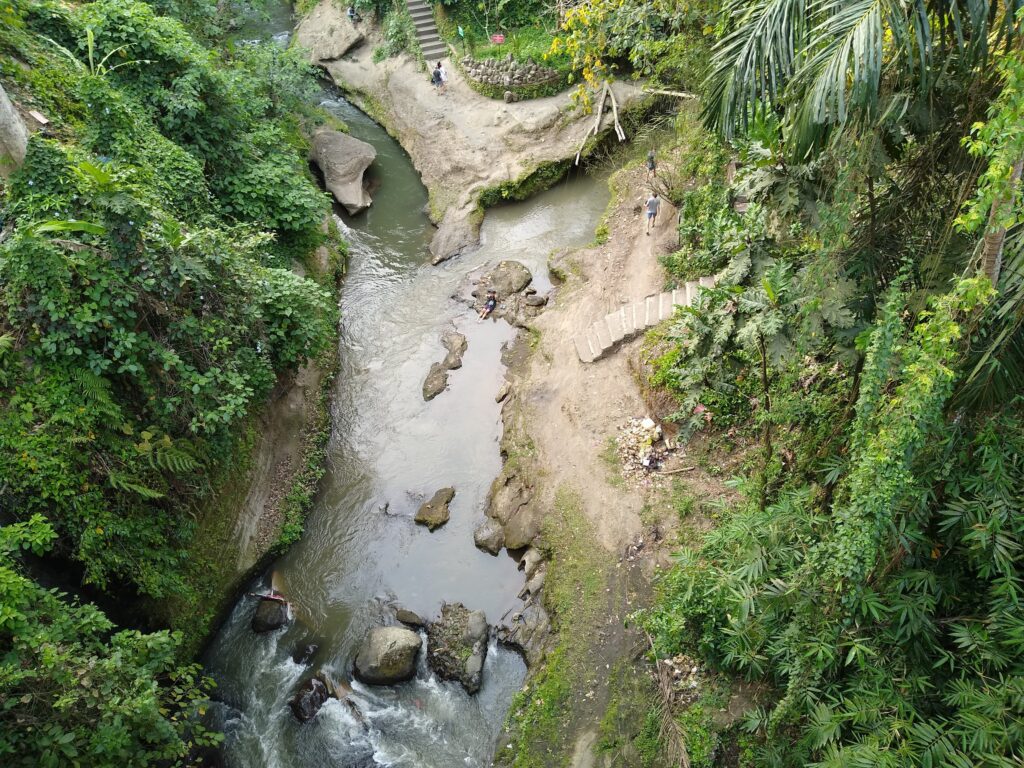
Just outside my home in Bali is the Campuhan Ridge walk, where Instagrammers like to pose. At the end of the ridge, two rivers flowing down from the central highlands meet, and it is this confluence of two different streams that gives the place its name — Campuhan, from the word campur, to mix. A gorgeous temple sits on the embankment to mark the power of this meeting.

Much of the richness of our daily lives comes from campuhan, except that we do not notice when confluence has occurred and produced for us a richness we take for granted. If we take the cooking of the countries of Bumantara, we can see how any dish from any place is a campuhan. Just pick anything. Say Vietnamese food: you can immediately taste the Chinese, Indian, Thai, Malaysian, French in it — but it is none of those. It is very much Vietnamese.

You may look at any product you like using — say, an Apple MacBook or iPhone — and in it is the confluence of great technology and beautiful aesthetics. The greatest compliment paid to it is how others have followed suit.

I would like you to continue thinking about confluence, or campuhan, in your life. How did you meet your life partner? How did you get introduced to someone who helped you out in business or some other corner of life? We tend to think of these things as luck or as the power of networking. But in fact, it is about an unexpected mixture.

If you are nerdy, you can look at the discovery of DNA, where crystallography, biochemistry, model-building and biological intuition came together. Or Velcro, where George de Mestral went walking with his dog and examined the burrs that had clung to its fur. Or the Sony Walkman, which involved no new technology at all but came about because Akio Morita’s daughter wanted to listen to music while she was moving.

The word entrepreneur means one who undertakes, but its deeper root is someone who reaches into the space between things and grasps what is there — from the French entre (between) and prendre (to grasp). The economic usage was coined by Richard Cantillon in the 1730s — his Essai was published posthumously in 1755 — to describe someone who buys at a known price and sells at an unknown one, bearing the risk of the gap. Joseph Schumpeter gave entrepreneurship its most modern rendition: neue Kombinationen — “new combinations.” In his view, the entrepreneur is not a maker of new substances, but a maker of new junctions.

Campuhan.

I have used Western examples here only to speak to other nerdy Western-educated people like myself. But Bumantara has known entrepreneurship for centuries. The Bugis sailors, the Hokkien merchants who sailed the Nanyang, the Gujarati traders who threaded the archipelago understood entrepreneurship long before the word made it into an MBA curriculum, before transdisciplinarity had to be invented in order to break silos. They lived between languages, between religions, between currencies. They lived in the campuhan.

How does this apply to what we are doing at WE-Empower? We are about the power of confluence. Outside talent — from around the globe, or from an entirely different background and age — coming alongside an enterprise builder, and journeying together for a bit. As short as a week, ideally three to six months. The difference is what creates new solutions and new value.

The EMAS Exchange Fellowship is drawing on this “methodology,” this “theory of change” — if we are indeed forced to use such words. But really, it is only about bringing difference and diversity together. Someone from outside comes alongside the local enterprise builder, and they make a new combination.

We are not inventing this. We are recovering it.

By Leng Lim

Bumantara: a name for Southeast Asia and why we use it

We work in Bumantara, the land in between.

It is a name for this region as itself.
Not as a corner of someone else’s compass. Not as “south” or “east” of anywhere else.
A name that claims an identity.

It is a simple word with a deep memory.
Bumi is earth, land, soil.
Antara is between, in the middle.

Sutan Takdir Alisjahbana used this term in 1987 when he spoke of Southeast Asia “standing before a great historical age.” He saw signs of awakening in a region shaped by meeting points. Between the world’s two great oceans. Between China and India. Between Australia and Asia. A crossroads, not a margin.

For him, what distinguishes Bumantara is not power in the usual sense. It is the position, and what position makes it possible. Over centuries, this region has absorbed and internalized many of the world’s major cultural streams. It has learned, the hard way, how to hold differences close.

So when we say we work in Bumantara, we are not trying to be poetic for its own sake. We are naming a reality.

Bumantara is best understood as flow, not borders. People, knowledge, trade, language, memory. It is a place where many currents move at once, and where living with difference is not a slogan. It is practice.

That understanding shapes our method. At WE-Empower, we convene and catalyze. We bring together people who would not otherwise meet, and create conditions for real exchange, the kind that strengthens rather than extracts.

The flourishing we seek is concrete. Businesses grow. Livelihoods strengthen. Communities prosper. Bumantara is home to around 700 million people, and MSMEs employ the majority of them. When these enterprises strengthen, the ground beneath communities holds.

That is the spirit behind the EMAS Exchange Fellowship. Gold meets gold. Both are transformed.

Weaving Future-Ready Bumantara

An Unfinished Story

Southeast Asia is a young region in historical time. Barely a lifetime ago, most of its nations were emerging from colonial rule and conflict. It began poor, rural, and uncertain of its place in the world. Yet in just a few decades, it transformed. Villages and kampong became sprawling megacities, its urban population swelling elevenfold since 1950. Economies once reliant on subsistence farming began to attract the world’s largest flows of foreign investment, collectively drawing more FDI than China for the first time in 2023. This was Southeast Asia’s remarkable rise: resilience against the odds, pragmatism turned into progress.

But every journey leaves its traces. Much of the region’s growth was built on state concessions and patronage rather than competition. Unlike East Asia, which produced global champions in automobiles, electronics, and technology, Southeast Asia’s boom rested on cheap labor, cheap resources, and export industries that thrived on volume over value. The region kept moving forward, but with fragility underneath.

At the same time, its people have been on the move. Skilled Southeast Asians continue to leave in search of better prospects abroad, draining talent from the very places that need it most. Migration often unfolds in steps: from village to provincial town, then to the capital, onward to Singapore or Hong Kong, and finally to global hubs in the West. The vacuums they leave behind, in schools, clinics, and enterprises, fall hardest on the places least able to absorb the loss – across Southeast Asia, the region we call Bumantara.

The Backbone That Bears the Most Weight

Nowhere is this more visible than among Bumantara’s micro, small, and medium enterprises (MSMEs): the everyday shops, farms, workshops, and small factories that form the true backbone of its economies.

More than 11 million of them make up over 90% of all enterprises and employ the majority of the workforce. And yet their contribution to GDP averages only 36%, a stark productivity gap that tells the story of enterprises operating far below their potential.

The most immediate constraint is capital. Nearly half of MSMEs have no access to formal credit, and most survive on cash reserves that last less than six months. But the deeper constraint is talent. MSMEs struggle to attract and keep capable people, competing against multinationals and startups that offer higher salaries and greater prestige. Gaps in digital, financial, and managerial skills limit their ability to innovate or adopt new practices. Unlike large corporations, they rarely have the networks, time, or resources to seek outside expertise. They are doing the work of building communities and livelihoods, largely alone.

Geography makes this harder still. Bumantara is one of the most fragmented regions on earth: thousands of islands, dozens of languages, markets separated by sea and distance. The knowledge, tools, and networks that could help MSMEs grow exist somewhere, but there is no clear bridge to reach them.

The Missing Bridge

MSMEs are not peripheral to Bumantara’s economy. They are its foundation. When they underperform, the whole region underperforms.

Future-readiness is not simply a matter of better tools or faster internet. It requires a shift in mindset: toward lifelong learning, toward openness, toward the willingness to try new things and adapt. Mindset is shaped by culture, habits, and belief, and it is the hardest thing to change. Even the highly educated may resist it, while a street vendor or migrant worker, long accustomed to resourcefulness in adversity, may prove more adaptable when systems shift. What matters is not mastering today’s knowledge, but cultivating the humility of a beginner’s mind.

But mindset alone is not enough. Even those ready to change cannot adapt without visible routes that connect effort to opportunity. Pathways make mindsets real: networks that let talent reach the enterprises that need it, connections that turn good intentions into shared practice, relationships that transmit not just skills but confidence and resilience. Mindset without pathways stays abstract. Pathways without mindset go unused. The two have to come together.

Bumantara does not lack ambition, and it does not lack talent. What it lacks are the connections between them: between MSMEs that need expertise and the skilled professionals, within the region and beyond, who have the capacity and often the desire to contribute. That is the gap WE-Empower exists to close. Our mission is a future-ready Bumantara, built enterprise by enterprise, through partnerships that are practical, mutual, and grounded in place. We start with MSMEs because that is where the need is greatest, the potential most untapped, and where the right connection can change the most.


This whitepaper is prepared by Leng Lim and Denny Halim for WE-Empower.
Leng Lim is the co-founder and serves as Chief Convener & Catalyst of WE-Empower. Denny Halim is Head of Program.