
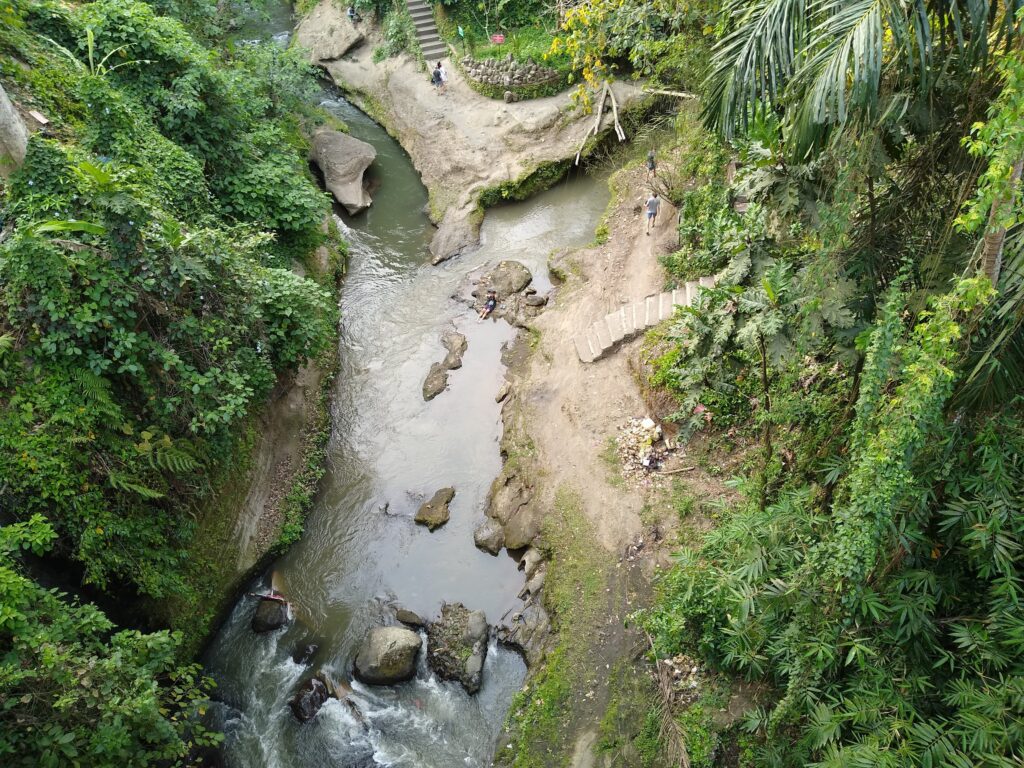
Just outside my home in Bali is the Campuhan Ridge walk, where Instagrammers like to pose. At the end of the ridge, two rivers flowing down from the central highlands meet, and it is this confluence of two different streams that gives the place its name — Campuhan, from the word campur, to mix. A gorgeous temple sits on the embankment to mark the power of this meeting.
Much of the richness of our daily lives comes from campuhan, except that we do not notice when confluence has occurred and produced for us a richness we take for granted. If we take the cooking of the countries of Bumantara, we can see how any dish from any place is a campuhan. Just pick anything. Say Vietnamese food: you can immediately taste the Chinese, Indian, Thai, Malaysian, French in it — but it is none of those. It is very much Vietnamese.
You may look at any product you like using — say, an Apple MacBook or iPhone — and in it is the confluence of great technology and beautiful aesthetics. The greatest compliment paid to it is how others have followed suit.
I would like you to continue thinking about confluence, or campuhan, in your life. How did you meet your life partner? How did you get introduced to someone who helped you out in business or some other corner of life? We tend to think of these things as luck or as the power of networking. But in fact, it is about an unexpected mixture.
If you are nerdy, you can look at the discovery of DNA, where crystallography, biochemistry, model-building and biological intuition came together. Or Velcro, where George de Mestral went walking with his dog and examined the burrs that had clung to its fur. Or the Sony Walkman, which involved no new technology at all but came about because Akio Morita’s daughter wanted to listen to music while she was moving.
The word entrepreneur means one who undertakes, but its deeper root is someone who reaches into the space between things and grasps what is there — from the French entre (between) and prendre (to grasp). The economic usage was coined by Richard Cantillon in the 1730s — his Essai was published posthumously in 1755 — to describe someone who buys at a known price and sells at an unknown one, bearing the risk of the gap. Joseph Schumpeter gave entrepreneurship its most modern rendition: neue Kombinationen — “new combinations.” In his view, the entrepreneur is not a maker of new substances, but a maker of new junctions.
Campuhan.
I have used Western examples here only to speak to other nerdy Western-educated people like myself. But Bumantara has known entrepreneurship for centuries. The Bugis sailors, the Hokkien merchants who sailed the Nanyang, the Gujarati traders who threaded the archipelago understood entrepreneurship long before the word made it into an MBA curriculum, before transdisciplinarity had to be invented in order to break silos. They lived between languages, between religions, between currencies. They lived in the campuhan.
How does this apply to what we are doing at WE-Empower? We are about the power of confluence. Outside talent — from around the globe, or from an entirely different background and age — coming alongside an enterprise builder, and journeying together for a bit. As short as a week, ideally three to six months. The difference is what creates new solutions and new value.
The EMAS Exchange Fellowship is drawing on this “methodology,” this “theory of change” — if we are indeed forced to use such words. But really, it is only about bringing difference and diversity together. Someone from outside comes alongside the local enterprise builder, and they make a new combination.
We are not inventing this. We are recovering it.
By Leng Lim